
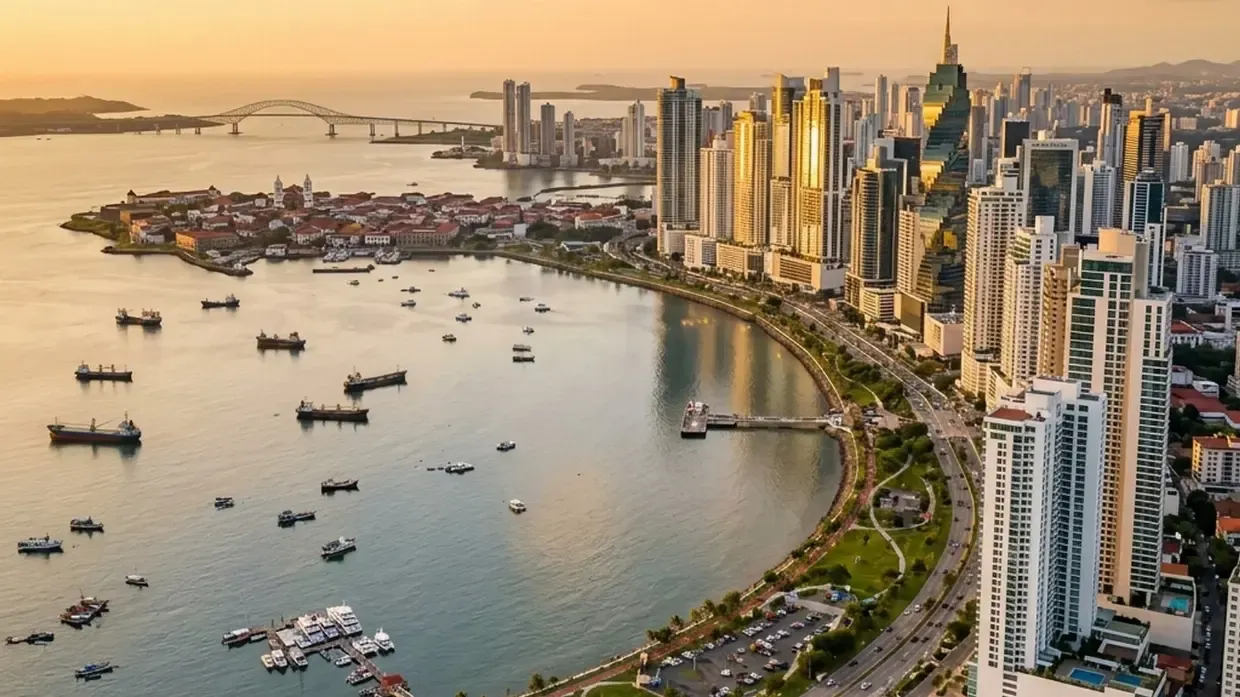
TLDR: Foreigners buy titled property in Panama outright, with the same legal rights as Panamanian citizens. No local partner, no special permits, no residency required. Every transaction is in US dollars — Panama has been fully dollarized since 1904. Gross rental yields run 5–10% depending on neighborhood. The buying process from offer to title registration typically completes in 30–60 days for resale.
The 8 steps:
1. Define your objective
2. Choose the right neighborhood
3. Select property type (resale vs pre-construction)
4. Understand full costs
5. Engage an independent attorney
6. Sign the Promesa de Compraventa
7. Close with the Escritura Pública
8. Register with the Registro PúblicoThis guide walks each step with the data you need to do it right.
Investing in Panama real estate has produced consistent returns for foreign investors for reasons that are structural, not circumstantial: a fully dollarized economy, equal foreign ownership rights under constitutional law, rental yields that beat most US and Latin American markets, and a 9-year inventory low as of 2026. In addition, a Qualified Investor Visa program converts a $300,000 real estate purchase into a pathway to Panama residency, with an October 15, 2026 threshold deadline that is driving concentrated buyer activity.
This guide is the complete map for investing in Panama real estate. It covers the investment case, the legal framework, the step-by-step buying process, the cost structure, and the post-purchase decisions that determine whether the investment performs. Every major topic links to a dedicated post in our research series where the full data lives.
In short, foreign investors can buy titled property in Panama with full ownership rights, no special permits, and no residency requirement, per Panama Law 8 of 1994 and its subsequent amendments. The purchase process involves a Promesa de Compraventa (promise to purchase), independent legal due diligence including a Registro Público title search, and a notarized Escritura Pública (public deed) that is registered in the buyer’s name. Total buyer-side closing costs run 2–4% of the purchase price. Gross rental yields in Panama City’s top neighborhoods run 5–10% in USD. All transactions, furthermore, are denominated in US dollars, since Panama has no local paper currency. Sources: Coastal Panama Properties, TheLatinvestor [1], Kraemer & Kraemer [2].
Investing in Panama Real Estate: The Investment Case in Brief
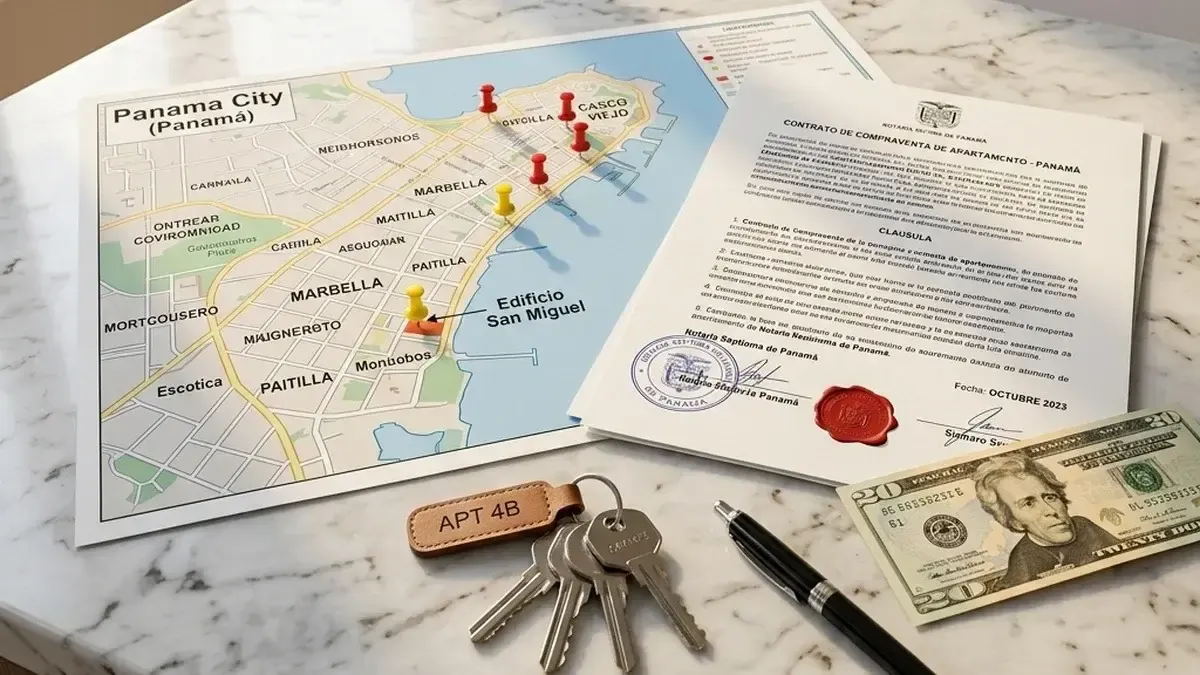
The investment case for investing in Panama real estate rests on four structural factors that distinguish it from most alternative offshore markets.
Yields in USD. Panama City’s gross rental yields average approximately 7.7% citywide, with El Cangrejo delivering 8–10% and San Francisco running consistently near 7.9% with a 4–6% vacancy rate. These yields, in addition, are earned and repatriated in US dollars with no currency conversion at any stage. For a full breakdown of what each neighborhood produces, see our Panama Real Estate ROI guide.
No currency risk. Panama has used the US dollar as its only circulating paper currency since 1904. The Panamanian Constitution prohibits the issuance of paper Balboa notes; as a result, dollarization is constitutionally locked and cannot be reversed by a policy decision. Panama has no central bank and cannot devalue its currency. This removes the single risk that has most damaged offshore real estate returns across Latin America: currency devaluation eating yields before they reach the investor’s account. See the full analysis in our Panama dollarized economy guide.
Legal Protection and the Residency Deadline
Legal equality for foreigners. Panama Law 8 of 1994 gives foreign nationals the same property ownership rights as Panamanian citizens on titled real estate. No local partner, no trustee structure, no special category of ownership is required. A foreigner buys, holds, and resells titled property directly in their own name. Full legal framework details are in Can Foreigners Buy Property in Panama?
QIV deadline. Panama’s Qualified Investor Visa (QIV) requires a minimum $300,000 real estate investment and grants permanent residency. That minimum increases to $500,000 after October 15, 2026. For investors considering the residency pathway, that date is a hard deadline; resale property that closes by August 2026, therefore, is the safe path to hit it. Our Panama Golden Visa guide covers the requirements in full.
For a side-by-side comparison of how Panama stacks up against US alternatives on the same capital, see Panama vs Miami: Where Does $300,000 Work Harder?
Understanding your legal footing before you buy

Two title types exist in Panama, and they are not equivalent. Titled property (Finca registrada) gives the buyer full ownership registered in the Registro Público, Panama’s national property registry. Every titled property, furthermore, has a unique finca number that can be searched publicly to confirm ownership, boundaries, liens, and encumbrances.
Right of Possession (Derecho Posesorio or ROP), in contrast, is an unregistered claim based on occupation and use. ROP land cannot be used to qualify for the QIV, cannot typically secure bank financing, and carries meaningful legal risk, particularly in areas where formal title is disputed or where the government may assert rights. As a result, ROP is not recommended for foreign investors seeking a clean, bankable asset.
The distinction matters most in beach and rural areas, where ROP land is common and often marketed without the distinction being clear. Panama City condominiums, however, are titled. The risk lives outside the city in underdeveloped coastal areas. Our Title Deed vs Right of Possession guide covers the full legal distinction, the risks, and how to verify before you commit.
Step 1: Define your investment objective
Before engaging an agent or reviewing listings, define what the investment needs to do. In fact, the right answer changes almost every subsequent decision.
Cash flow from day one. Resale property in El Cangrejo or San Francisco. Close in 30–60 days, rent immediately. Yields 7.9–8.9% gross. No income gap.
Capital appreciation with deferred income. Pre-construction from a vetted developer. Lower entry price than comparable new-build. Staged payment plan reduces upfront cash requirement. 18–36 months before rental income begins, with 12–24 month delay risk built into that estimate.
Residency through real estate (QIV). Minimum $300,000 in titled property. October 15, 2026 deadline. Resale is the only reliable path to hit that date — pre-construction delivers no certainty on timing. Attorney confirmation of QIV eligibility is required before offer, not after.
Maximum yield on existing capital. Two studios in El Cangrejo at current price points vs one two-bedroom in San Francisco. Different risk profiles, different income streams, different tenant management complexity.
Your objective determines your neighborhood, your property type, your financing approach, and your timeline. Investors who skip this step optimize for the wrong thing.
Step 2: Choose the right neighborhood
Panama City’s neighborhood differences are not aesthetic preferences. In fact, they are documented yield gaps of up to five percentage points between neighborhoods within a few kilometers of each other.
| Neighborhood | Gross yield (2026) | Tenant profile | Notes |
|---|---|---|---|
| El Cangrejo | 8–10% | Students, expats, young professionals | Highest yield in city |
| San Francisco | ~7.9% | Mixed expat/professional | 94% occupancy, deepest resale market |
| Costa del Este | 5–7% | Multinationals, corporate leases | Rents up 15% YoY, low vacancy |
| Marbella | 6–8% | Professionals, expats | Liquid, stable |
| Casco Antiguo | Varies | STR where permitted | Heritage scarcity, appreciation play |
| Punta Pacifica | 4–6% | Mixed | Aging stock, yields below city average |
| Punta Paitilla | 3–5% | Declining | Older towers flat to negative appreciation |
The neighborhoods shown most frequently to first-time foreign buyers — Punta Pacifica and Punta Paitilla — consistently underperform on investor metrics. El Cangrejo, San Francisco, and Costa del Este serve different investor profiles but all have stronger fundamentals. The full neighborhood-by-neighborhood breakdown, including what $300,000 produces in each area, is in our Best Neighborhoods in Panama City guide.
Step 3: Decide between resale and pre-construction
This decision drives everything downstream: income timeline, capital requirement, risk profile, and whether a visa deadline is achievable.
Resale: closes in 30–60 days, rental income starts immediately, and you inspect the actual unit before signing. Resale condos in Panama City average $1,700–$2,100 per square meter, and negotiation room of 5–12% below asking exists in most corridors.
Pre-construction: entry price 15–30% below comparable new-build finished product, staged payment plan reduces upfront cash requirement, appreciation potential during construction. However, delivery delays of 12–24 months beyond promised dates are common, not exceptional. There is no rental income during the construction period, which typically runs 18–36 months, so developer vetting is mandatory before any deposit.
For investors who need to hit the QIV October 2026 deadline, pre-construction is eligible but risky given delivery timing uncertainty. Resale, therefore, is the lower-risk path to a certain close date.
Our Pre-Construction vs Resale guide has the full decision framework, including the developer vetting checklist and a side-by-side scenario table for seven investor situations, available here.
Step 4: Understand the Full Cost Picture Before You Make an Offer
The purchase price is not the number to budget against. Instead, the total capital requirement for a foreign buyer in Panama includes:
Day-One Acquisition Costs on a $300,000 Property
| Cost item | Amount | Notes |
|---|---|---|
| Down payment (resale, bank financing) | $90,000–$120,000 | 30–40% required for foreign buyers |
| Legal fees | $1,500–$3,000 | Independent attorney — non-negotiable |
| Notary fees | $200–$500 | For deed preparation |
| Public Registry filing | ~0.3% (~$900) | Title registration |
| Property clearance certificates | $200–$500 | Tax and utility confirmations |
| Reserve / contingency | $5,000–$10,000 | HOA arrears risk, inspection surprises |
| Total buyer-side closing costs | ~2–4% (~$6,000–$12,000) | Excluding down payment |
Note: Panama’s transfer tax (2% of registered value or sale price, whichever is higher) is paid by the seller, not the buyer.
Ongoing Annual Costs
| Cost item | Typical range |
|---|---|
| HOA fees | $70–$315/month ($840–$3,780/year) |
| Property tax | $0–$2,500/year (many properties exempt up to $120,000 registered value) |
| Property management | 10–15% of gross rent |
| Maintenance reserve | 1–2% of property value/year |
In fact, HOA fees are the largest single drag on net yield, capable of reducing gross yield by 1.5–2 percentage points in high-amenity buildings. Always request 12 months of HOA statements and the reserve fund status before any offer. A building running a structural reserve deficit carries hidden risk that the purchase price does not reflect.
The full cost breakdown — including day-one capital model, three financing pathways, and the FECI surcharge for non-resident mortgage borrowers — is in our Down Payments, Costs, and Financing guide.
Step 5: Engage Your Legal Team (Investing in Panama Real Estate Requires This Before Anything Else)
This step happens before the offer goes in, not after.
Your attorney’s job in a Panama real estate transaction:
– Pull the Registro Público certificate: confirms finca number, current registered owner, property boundaries, existing mortgages, liens, and encumbrances
– Request a certified gravámenes (encumbrance) search: confirms no undisclosed debt attached to the title
– Verify property tax and utility arrears: any outstanding balance transfers to the buyer at close
– Request HOA arrears confirmation directly from the building administrator
– Review the sales promise contract (Promesa de Compraventa) before you sign or pay anything
– Coordinate with the notary for deed preparation and registration
Attorney fees for a standard residential transaction run $1,500–$3,000, and this is not a negotiable cost. An investor who relies on the agent’s attorney — or on the seller’s notary — is not represented, since the attorney represents whoever is paying them.
The single biggest red flag in any Panama transaction is pressure to pay a deposit before the finca number has been independently verified in the Registro Público. That search takes less than a day, and no legitimate transaction requires you to skip it. See How to Find a Trustworthy Real Estate Agent in Panama for the full agent vetting framework.
Step 6: Make the offer — Promesa de Compraventa
Once due diligence is complete and the title is confirmed clean, therefore, the transaction formally begins with a Promesa de Compraventa (Promise to Purchase Agreement). This is a legally binding contract that sets:
- Agreed purchase price
- Earnest money deposit (typically 10% of purchase price)
- Closing date
- Contingencies (financing, inspection results, title clean confirmation)
- Penalty clauses if either party withdraws
Critical point on deposit handling: never pay the earnest money deposit directly to the seller or the agent. Deposits go into an escrow account — held by your attorney or a reputable escrow service — and are released only when all conditions of the agreement are satisfied. Wire transfers to personal accounts or offshore locations are a red flag, per Kraemer & Kraemer’s transaction red alerts guide [3].
For pre-construction: the Promesa de Compraventa is the contract with the developer. It should include a delivery penalty clause specifying compensation for delays. If the clause is absent or nominal, the buyer accepts delay risk with no contractual remedy. Have your attorney identify this before signing.
Step 7: Financing (if applicable)
Panama’s banking system lends to qualified foreign buyers, but, however, the terms differ from domestic buyers:
Bank mortgage: 60–70% LTV for foreign buyers (30–40% down payment required). Interest rates run 6.5–8.5% in 2026. Non-residents without Panama permanent residency pay a FECI surcharge of 1% annually on the loan balance. Banks offering mortgages to foreign buyers include Banco General, Banistmo, Global Bank, Banco Nacional de Panamá, and Davibank, and mortgage approval typically adds 30–60 days to the closing timeline.
Pre-construction developer financing: staged payment plan typically structured as 10–33% at signing, milestone payments during construction, balance at delivery. No bank qualification is required, and this gives access to assets that a full down payment would make unreachable. The risk, instead, is the developer’s financial health rather than a regulated lender.
Seller financing: available in a minority of resale transactions, particularly with motivated sellers. Terms are negotiated directly, with no bank qualification process — typically shorter terms (3–7 years) with a balloon payment.
For all-cash buyers, the transaction is faster and avoids FECI, LTV limits, and bank processing timelines. Cash closes in 30–45 days from accepted offer, while bank-financed closes typically run 60–90 days.
Step 8: Close — Escritura Pública and title registration
The closing process in Panama has two distinct stages:
Escritura Pública (Public Deed): When the buyer makes final payment, both parties sign a public deed at a notary’s office. The notary drafts, certifies, and authenticates the deed, the legal instrument that transfers ownership. The buyer does not need to be physically present if they have granted a power of attorney to their Panamanian attorney, a common arrangement for offshore buyers who cannot travel for the closing.
Registro Público registration: the signed deed is submitted to Panama’s Public Registry, and registration typically takes 2–4 weeks. Once registered, the buyer is the legal, undisputed owner with a recorded finca entry in their name, and the title is publicly searchable and protected under Panamanian law.
Total closing timeline for resale: 30–60 days from accepted offer to title registration for cash buyers, and 60–90 days with bank financing. These timelines are why resale, not pre-construction, is the reliable path for investors who need to close before the QIV October 2026 deadline.
After closing: rental income, management, and taxes
Starting the rental. Most Panama City condominiums allow long-term rentals (30+ days). Some buildings restrict short-term rentals (under 30 days), so confirm building rules before you buy if short-term rental income is part of your model. In addition, furnished units command a 15–25% rent premium in high-demand corridors.
Property management. Self-managing from abroad is operationally difficult. Professional property management in Panama City, however, runs 10–15% of gross monthly rent and covers tenant sourcing, lease execution, rent collection, maintenance coordination, and vacancy management. Budget this into your yield model from day one, since it is not optional for most offshore investors.
Rental taxes. Non-resident property owners pay a 15% withholding tax on gross rental income in Panama, or may elect net income taxation. Panama operates a territorial tax system, so income earned outside Panama is not subject to Panamanian tax. Your home-country filing obligations are separate and determined by your country’s tax treatment of foreign rental income; therefore, engage a tax advisor in your home country before the first rent check arrives.
Property tax. Properties with a registered value up to $120,000 are exempt from annual property tax. Values above that threshold are taxed at rates from 0.5% to 1%. Many Panama City condominiums, as a result, fall partially or fully within the exemption range depending on their registered value. Confirm the registered value, not the market value, with your attorney before closing.
The residency pathway: QIV in 2026
A $300,000 minimum investment in titled real estate qualifies a foreign buyer for the Panama Qualified Investor Visa (QIV), which grants permanent residency. The $300,000 threshold increases to $500,000 after October 15, 2026, creating a concrete deadline for investors who want to combine the investment return with the residency benefit at the current minimum.
Practical close-by date to hit the October 15 threshold: August 2026. That, in turn, allows 30–60 days for resale closing and 30–45 days for QIV application preparation and submission.
The QIV grants permanent residency, not citizenship. Citizenship requires five continuous years of residency after QIV approval, and dependents (spouse and children under 25) can be included in the application. Our Panama Golden Visa 2026 guide has the full QIV requirements, documents, and application timeline.
Investing in Panama Real Estate: The 2026 Market Context
Panama City’s real estate market in 2026 is entering this buying cycle from a position of supply constraint. Inventory sits at a 9-year low, with the sharpest undersupply in the 1–2 bedroom segment in the city’s top three neighborhoods. Rents increased 8–15% year-over-year in 2025 and are projected to grow 2–5% through 2026. New construction costs, meanwhile, are up 15% year-over-year, which narrows the resale-to-new-build gap and makes well-maintained resale properties increasingly attractive on a cost basis.
GDP growth: 3.8% in 2026, 4.3% projected in 2027, per World Bank. US investor inquiries in Q1 2026 were up 12% year-over-year, per TheLatinvestor. Foreign buyers, furthermore, represent 25–40% of Panama City residential purchases.
The full market data — prices by neighborhood, yield and vacancy table, foreign buyer profile breakdown, and macro outlook — is in our Panama Real Estate Market Report 2026.
Frequently asked questions
Can foreigners own property in Panama?
Yes. Panama Law 8 of 1994 gives foreign nationals the same titled property ownership rights as Panamanian citizens. Foreigners buy, hold, and resell titled real estate directly in their own name — no local partner, no trustee structure, no special permit, no residency requirement, per TheLatinvestor’s foreign ownership guide [1]. The only restriction is on properties within 10 kilometers of the Panamanian border, where foreigners may not own land; that restriction does not apply to Panama City or the major coastal investment corridors.
How long does it take to buy property in Panama?
A standard resale purchase in Panama closes in 30–60 days from accepted offer to title registration. In summary, that timeline covers attorney due diligence (3–7 days), Promesa de Compraventa signing and deposit, and notarized deed preparation and Registro Público registration (typically 2–4 weeks). Bank-financed purchases add 30–60 days for mortgage approval. Pre-construction timelines are not closing timelines — they are delivery timelines, which run 18–36 months from signing, with common delays of 12–24 months beyond the promised date.
What is the minimum investment to buy property in Panama?
There is no legal minimum purchase price for foreigners buying titled property in Panama. The effective floor is set by the market: entry-level condominiums in El Cangrejo and surrounding neighborhoods start around $90,000–$120,000. The QIV residency threshold sets a practical minimum of $300,000 for investors seeking residency — a threshold that increases to $500,000 after October 15, 2026. Most investors targeting yield-optimized strategies deploy $200,000–$350,000 per unit in Panama City’s top-performing neighborhoods.
Do I need to be in Panama to buy property?
No. Foreign buyers commonly complete the entire purchase process remotely by granting a power of attorney to their Panamanian real estate attorney. The attorney signs the Escritura Pública on the buyer’s behalf at the notary’s office. Property inspections are conducted by the attorney or a hired inspector who reports back with photographs and condition notes. Many offshore buyers never visit Panama before closing — though a site visit before the offer is always advisable, particularly for first-time Panama investors.
What taxes apply when investing in Panama real estate?
At purchase: transfer tax (2% of registered value or sale price, whichever is higher) is paid by the seller. The buyer pays legal fees (1–1.5%), notary fees (0.1–0.25%), and Public Registry filing fees (approximately 0.3%). During ownership: properties with registered values up to $120,000 are exempt from annual property tax; values above that threshold pay 0.5–1% annually. Rental income for non-residents is subject to a 15% withholding tax on gross rent, or net income election, per Kraemer & Kraemer’s real estate tax guide [2]. Panama’s territorial tax system, however, means income earned outside Panama is not taxed by the Panamanian government.
Talk to an ICON Agent About Current Listings
Investing in Panama real estate has a clear case, and the process is straightforward when you know the steps and have the right team. The risk lives in the gaps — agents who do not pull the Registro Público before the offer, buildings with undisclosed HOA arrears, pre-construction contracts with no delivery penalty clause, neighborhoods that look attractive on gross yield but disappoint on net.
ICON pulls the Registro Público certificate before any offer goes in. We request HOA arrears from the building administrator on every resale, and we model net yield in USD — including HOA, management, tax, and vacancy — so the number you evaluate is what your investment actually produces. We decline pre-construction projects that fail our developer financial structure review.
The October 2026 QIV deadline is real. If residency through real estate is part of your plan, the window to act at the $300,000 threshold closes in August 2026 — enough lead time for a resale purchase and QIV application, not enough for a relaxed pre-construction schedule.
Talk to an ICON Advisor About Current Listings →
Sources
- TheLatinvestor — Panama foreign ownership rights, Law 8 of 1994
- Kraemer & Kraemer — Panama real estate taxes guide
- Kraemer & Kraemer — red alerts in Panama real estate transactions
 Estamos para ayudarte!
