
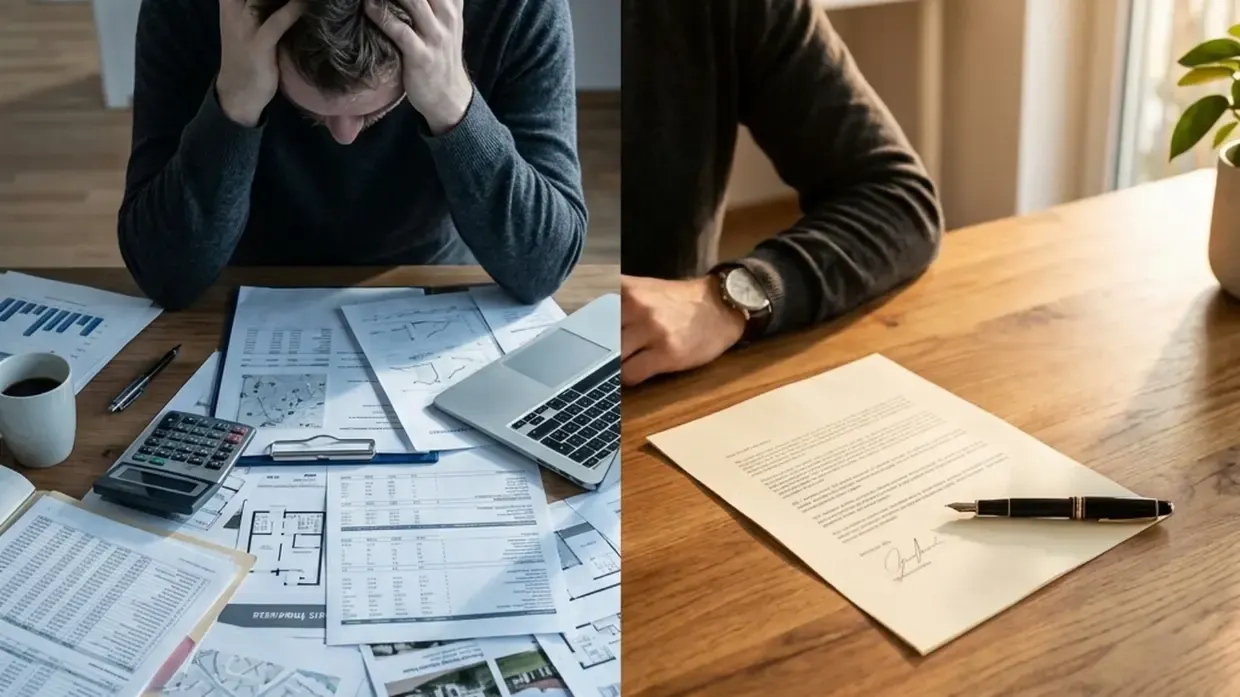
TLDR: Fear of investing in Panama real estate is not irrational. According to Mundo Expert’s Panama investment guide [1], 90% of foreign investors make mistakes, and most of them trace back to two things: not having enough information, and moving too fast once the emotional decision is made. The investors who do well are not the brave ones — they are the ones who got the right information, slowed down long enough to verify it, and then acted on a clear plan. That, in other words, is a process, not a personality trait.
Most people who reach out to ICON have already done their research. They know Panama is dollarized and that foreigners can own titled property outright. They know the yields are real, and they still do not buy.
Not because the numbers are wrong, but because the fear is louder than the numbers.
That is not a character flaw. It is how the brain works when the stakes are high and the geography is unfamiliar. The question is not whether the fear is there, since it almost always is; the question is whether it is telling you something useful or just telling you to stay still.
In short, fear of investing in Panama real estate generally comes from one of two places: legitimate concern about a specific risk that has not been resolved yet, or generalized anxiety about doing something unfamiliar in an unfamiliar country. The first kind is solvable. The second kind, however, gets resolved through process, not through waiting. Most first-time foreign investors in Panama sit in a cycle where they cannot move forward until they feel confident, and they cannot feel confident until they have moved forward. Breaking that cycle requires separating what is actually unknown from what just feels unknown. Sources: Mundo Expert [1], TheLatinvestor [2].
What the Fear of Investing in Panama Real Estate Is Actually Telling You
Fear of a major financial decision in a foreign country is not a signal to stop. It is a signal to investigate.
In fact, the distinction matters because the two responses — stopping vs. investigating — lead to completely different outcomes. The investor who stops tends to stay stopped, while the investor who investigates tends to find that most of what felt threatening was resolvable, and what remained was manageable.
TheLatinvestor’s 2026 risk and pitfalls report [2] documents that real estate fraud complaints to Panama’s Ministerio Público numbered over 5,100 from January to October 2025. That is not a reason to avoid Panama real estate; it is, instead, a reason to understand exactly what causes those complaints and to not do those things. Most trace back to four patterns: buying without title verification, skipping independent legal review, trusting verbal assurances over documented evidence, and moving fast because a deal felt urgent.
These are process failures, not Panama failures, and they happen in Miami, Medellín, and Dubai too. The difference is that foreign investors in unfamiliar markets often skip the verification steps that feel bureaucratic, because they are relying on the agent or developer to fill the gap.
The Four Risks That Are Real — and Solvable
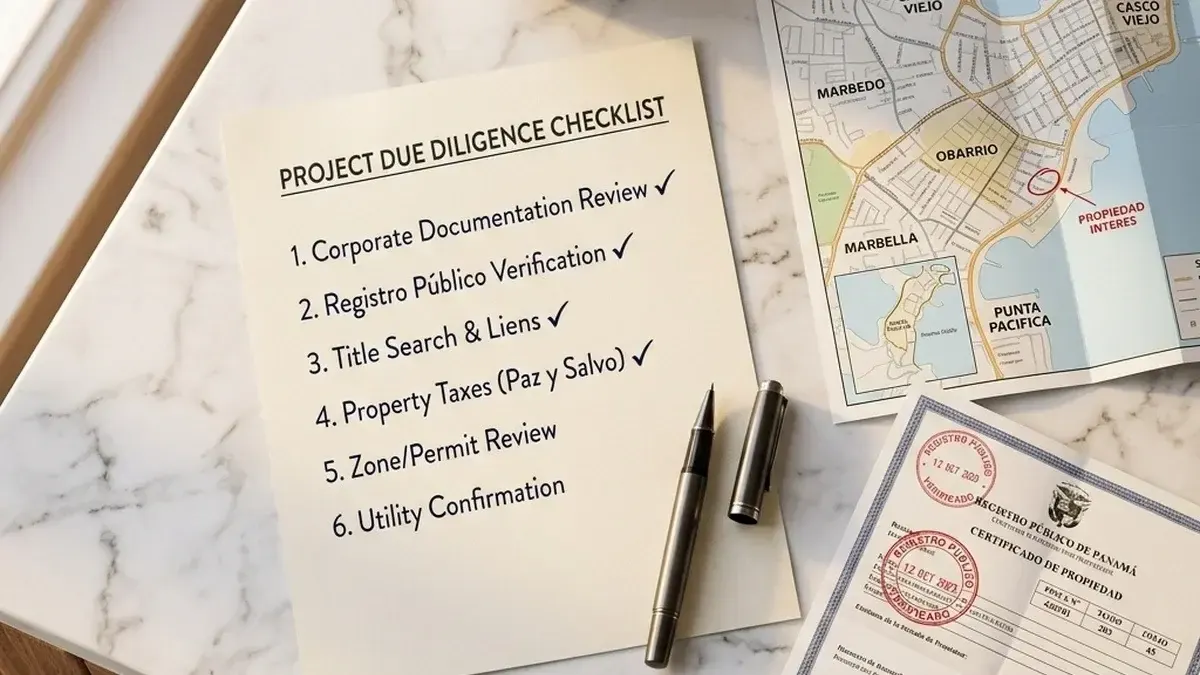
Title fraud. Real, but prevented by a Registro Público pull. Your attorney requests the finca certificate before any deposit leaves your account. If the title is clean, you know; if it is not, you walk away before you are committed. This is a 48-hour process, not a six-month investigation, per Casco View Life’s due diligence checklist [3].
Developer default on pre-construction. Real, but screened by checking construction financing, land title status, and the developer’s track record on delivered projects. An agent who cannot answer these questions, or resists asking them, is the signal.
Legal complexity. Real, but bounded. The purchase process in Panama — Promesa de Compraventa → attorney review → Escritura Pública → Registro Público registration — is a defined sequence with a defined cost. Attorney fees for a standard residential transaction run $1,500–$3,000, and that is the price of knowing you are protected.
Liquidity. Real, and worth planning for. Panama real estate is not a six-month asset. If your exit timeline is under two years, the math often does not work regardless of the market. However, if your timeline is five-plus years, the 20–30% faster sales velocity documented in recent years and the 9-year inventory low mean a well-priced property in a central neighborhood is not likely to sit, per Panama Realty Zone’s 2026 risk report [4].
These are the fears worth taking seriously. Each one has a specific resolution, and none of them requires indefinite waiting.
The Fears That Are Not What They Seem
Some fears about Panama real estate are not based on risks; they are based on assumptions that do not hold up under scrutiny.
“The government could confiscate my property.”
Panama’s constitution provides foreign investors the same property rights as Panamanian nationals, and the Foreign Investment Protection Law reinforces this. There is no legal mechanism for nationality-based expropriation, per Limitless Legal’s investment myths guide [5]. Panama’s economy runs on foreign capital, so the incentive structure runs in the opposite direction.
“I can’t get a mortgage as a foreigner, so I need cash.”
Not accurate. Panamanian banks lend to qualified foreign buyers at 60–70% LTV, with rates running 6.5–8.5% for non-residents. The down payment requirement, typically 30–40%, is higher than domestic buyers face, but financing is available. ChoosePanama’s buyer resource [6] covers this directly.
“I can’t sell once I’m in.”
Panama City’s sales velocity has run 20–30% faster than prior years, and inventory sits at a nine-year low. Well-priced titled properties in central neighborhoods — Punta Pacífica, Obarrio, Costa del Este — move. What does not move is overpriced inventory and properties in locations without rental demand. The liquidity concern is real for those assets; for a correctly priced property in a liquid corridor, however, it is not the barrier people assume.
“It’s too complicated to manage from abroad.”
Property management fees in Panama City run 8–12% of monthly rent. The manager handles leases, tenant screening, maintenance coordination, and rent collection, and the investor receives a monthly statement and a USD transfer. Most ICON clients manage their Panama properties from the US, Canada, or Europe without visiting more than once a year.
How to know you’re actually ready
Readiness for a Panama real estate investment is not a feeling. In fact, it is a checklist.
You know your objective
Are you buying for yield, capital appreciation, residency through QIV, or a combination? The answer changes which neighborhoods, which property types, and which price points to focus on. As a result, an investor without a clear objective tends to evaluate every property against every goal simultaneously, which produces paralysis, not a decision.
You have verified the legal framework for your situation
If you are a US citizen, you understand how Panama rental income interacts with your US filing obligations. If you are targeting QIV residency, you know the October 15, 2026 threshold change and what it means for your timeline. If you are financing, you know which Panamanian banks lend to foreign buyers in your country of residence.
You have an attorney
Not “you plan to find one.” Not “the agent said they have one.” Your attorney — engaged independently, whose fee you pay — is confirmed. No deposit moves before they pull the Registro Público certificate.
You have modeled the actual numbers
Not the developer’s projected yield, therefore, but your own model: purchase price, down payment, financing cost (if applicable), attorney and closing fees (2–4% of purchase price), HOA, property management, property tax if applicable, and expected gross rent based on comparable leases in the building. The number that comes out of that model is your net yield. If it still makes sense — and for most well-located Panama City properties, it does — you are making an informed decision, not an emotional one.
Your timeline is at least five years
This is not a rule; it is, instead, a probability statement. Over five-plus years, Panama’s trajectory (GDP growth, inventory compression, rising rents) works in your favor. Under two years, however, transaction costs and potential market timing work against it.
If you can answer those five points with specifics rather than intentions, you are ready. The fear does not disappear — it just stops being the loudest voice in the room.
What it looks like when the decision is made right
A US-based investor had been researching Panama for 18 months before reaching ICON. She had read everything and visited once, but she had a specific fear she could not resolve: she did not know what happened if she needed to sell in a hurry, and her previous research had not given her a clean answer.
The answer, when she finally asked it directly, in fact, was clear: for a titled apartment in Costa del Este priced within 5% of market value, average days on market in 2025 ran under 90. For a property priced 10% above comparable sales, it ran 180 or more. She was not buying an illiquid asset. She was buying a correctly priced asset in a liquid corridor — or not, depending on what she paid.
As a result, she made an offer on a two-bedroom in Costa del Este at 6% below asking, based on comparable sales ICON pulled from its own transaction database. The offer was accepted. She closed in 38 days. Her gross yield in year one was 7.1%. Net yield, after HOA, management, and property tax, was 5.4%.
She has since told us the 18 months of research were not wasted. They were the process that made the decision feel like a decision rather than a gamble. The fear was part of that process. It just should not have been the entire process.
Frequently Asked Questions
Is it normal to feel afraid about investing in Panama real estate?
It is. Fear of a large financial decision in an unfamiliar jurisdiction is a rational response, not a character flaw. According to Mundo Expert’s investment guide [1], 90% of foreign investors make at least one mistake in Panama, and most trace back to moving too fast once the emotional attachment to a property overcomes the due diligence process. The fear itself is not the problem; letting it either paralyze you indefinitely or, conversely, letting the desire to escape it push you into a fast decision, those are the two failure modes.
What are the biggest legitimate risks for foreign buyers in Panama?
The four risks worth taking seriously are title fraud (prevented by Registro Público verification before any deposit), developer default on pre-construction (screened by verifying construction financing and developer track record), legal complexity (bounded and resolvable with an independent attorney at $1,500–$3,000 for a standard transaction), and liquidity risk (real for short-hold investors, but manageable for five-plus year timelines in central Panama City corridors), per Panama Realty Zone’s 2026 risk report [4].
Can the Panamanian government take my property?
No. Panama’s constitution provides foreign investors the same property rights as nationals, and the Foreign Investment Protection Law reinforces this. There is no legal mechanism for nationality-based expropriation. Panama’s economy is built substantially on foreign capital and foreign financial services, so the government’s structural incentive is to protect foreign investment, not to threaten it, per Limitless Legal’s investment myths guide [5] and ChoosePanama’s expropriation fears guide [6].
How do I know if I’m ready to overcome the fear of investing in Panama real estate?
Readiness is a checklist, not a feeling. You are ready when you have a clear investment objective (yield vs. appreciation vs. residency), a verified understanding of how Panama income interacts with your home-country taxes, an independent attorney confirmed, a net yield model built from real inputs (not developer projections), and a timeline of at least five years. If any of those are missing, that is what to work on next, not waiting until the fear passes on its own.
What is the profile of a buyer who gets into trouble in Panama?
TheLatinvestor’s risk and pitfalls report [2] documents it clearly: the buyer most commonly targeted is new to the country, emotionally attached to a specific property, in a hurry to close (often around visa deadlines or “limited inventory” pressure), and reluctant to bring in independent legal help because they trust the agent. Urgency and emotional attachment are not wrong; however, they become dangerous when they replace the verification steps that make the investment safe.
Schedule a Free Consultation With an ICON Advisor
Most of what investors fear about investing in Panama real estate is either solvable or already solved. Neither the expropriation risk nor the currency risk actually exists. Title fraud risk exists but is fully preventable with the right process, and liquidity risk is real but manageable if you know your timeline and buy correctly.
What ICON provides is not reassurance. It is, instead, the information that turns a vague fear into a specific question, and then the answer.
We pull the Registro Público before any offer goes in. We model net yield from real inputs, and we decline pre-construction projects that do not pass our financial structure review. When the data on a property does not favor the buyer, in summary, we say so.
Schedule a Free Consultation With an ICON Advisor →
Sources
- Mundo Expert — common mistakes in Panama real estate investment
- TheLatinvestor — Panama risks and pitfalls 2026
- Casco View Life — due diligence checklist for foreign investors
- Panama Realty Zone — 2026 risk report
- Limitless Legal — investment myths about Panama, 2025
- ChoosePanama — expropriation fears and mortgage access for foreigners
 Estamos para ayudarte!
