
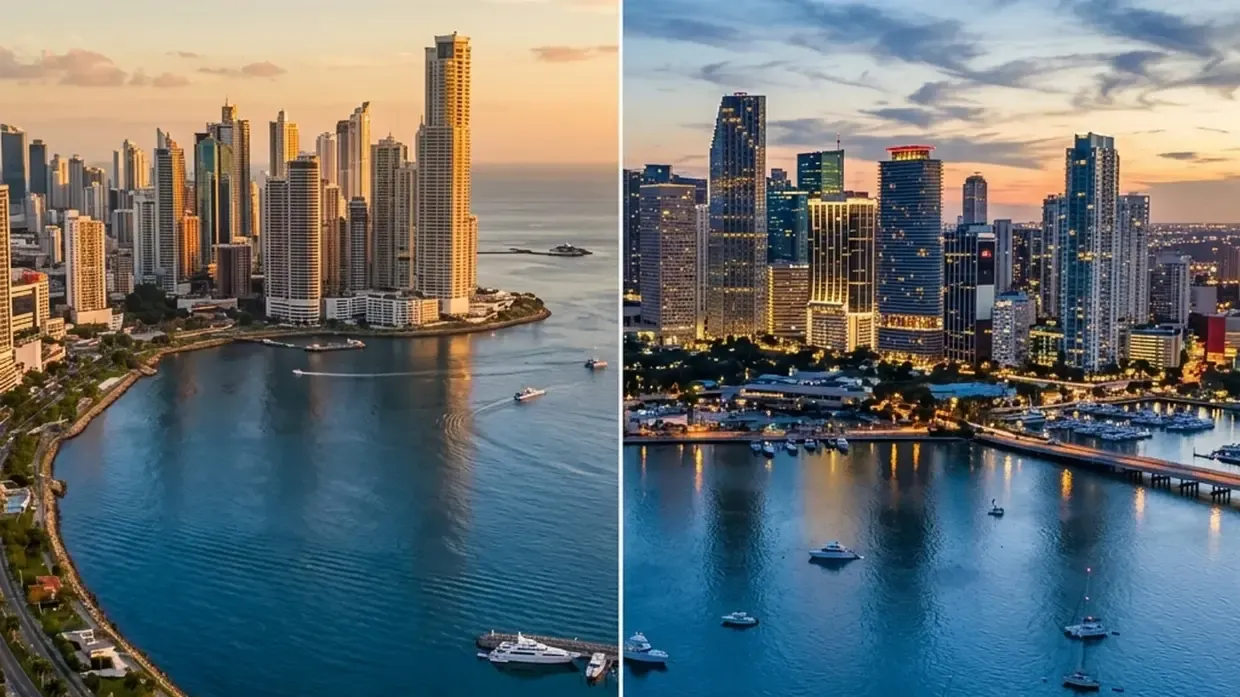
TLDR: Panama vs Miami real estate investment at $300,000 is not a close call. That budget buys a titled, cash-flowing property in Panama City with roughly 5.2% net yield, no HOA, low property tax, and a residency visa as an option. The same capital in Miami sits below the Brickell entry threshold and faces 13 months of condo supply overhang. Panama’s total annual returns run 9–11% including appreciation; Miami net yields run 2–4%.
The most common question a foreign investor asks when Panama comes up is, “Why Panama when I could just buy in Miami?” It is a fair question — Miami is familiar, with liquidity, market history, and name recognition. The deeper question, however, is whether it works at your price point, in your time horizon, with the returns you actually need.
$300,000 is where this Panama vs Miami real estate investment comparison sharpens. That figure is not chosen for rhetorical effect; it is Panama’s Qualified Investor Visa minimum. At that number, you are not just picking a city — you are deciding which market actually makes the math work.
In short, at $300,000, Panama and Miami produce different outcomes. Panama’s average gross rental yield was 6.94% in Q2 2026 per Global Property Guide [1], against Miami net yields of 2–4%. Median Brickell condos in Q1 2026, meanwhile, were priced at $660,000–$705,000 per Brickell Sold’s Q1 market report [2]. At $300,000, you are below the threshold for Miami’s most liquid submarket; in Panama, by contrast, you are in the middle of it.
Panama vs Miami Real Estate Investment: What $300,000 Actually Buys
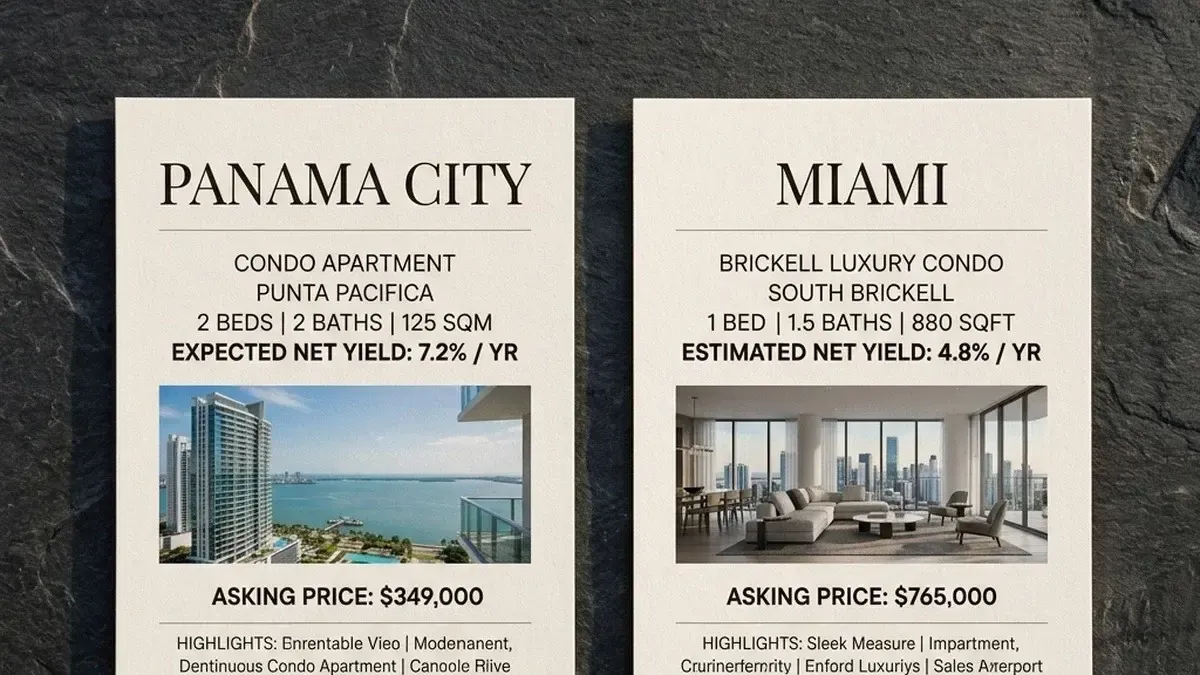
Panama and Miami both use the US dollar. Beyond that, however, the two markets operate under different supply levels, tax rates, and yield profiles in 2026.
Panama at $300,000
$300,000 in Panama City places you in the target zone. In Punta Pacifica, a quality two-bedroom runs $280,000–$340,000. In El Cangrejo, the same capital buys a larger unit in a building with strong short-term rental occupancy, or potentially two smaller units if you want to split the investment. Either way, you are not compromising on neighborhood.
Panama City’s inventory sits at a nine-year low per Panama Home Realty, and rents rose 8–15% in 2025 across high-demand neighborhoods. TheLatinvestor’s 2026 price forecasts [3] project cumulative appreciation of 18–25% over five years in Panama City. Is that guaranteed? No return is — but the drivers behind it (supply constraint, dollar denomination, rising tenant demand) are documented and current.
At $300,000, you also qualify for Panama’s Qualified Investor Visa, which grants residency through a real estate purchase. The visa does not require you to live there; whether you want Panamanian residency or not is a separate question. It is available at this price point without additional cost, and that is not true of Miami.
Miami at $300,000
Miami is a strong market, and the argument against it at $300,000 is not about Miami generally — it is about what that figure actually buys.
Brickell Sold’s Q1 2026 research [2] puts the median Brickell condo at $660,000–$705,000. A $300,000 purchase in Miami-Dade, as a result, goes into outlying markets with weaker tenant demand and higher vacancy exposure. It also runs into Miami’s supply problem: Miami-Dade County had 13 months of condo inventory in early 2026 per Florida Home Group Realty’s 2026 analysis [4], well above the 6–7 months that define a balanced market. That overhang compresses both rental rates and resale appreciation.
Miami’s cost structure is also less investor-friendly than it looks on paper. HOA fees in Miami condo buildings typically run $500–$1,000 per month — $6,000–$12,000 per year before management, maintenance, or vacancy — and property tax runs 1.5–2% annually. On a $300,000 property, that is $4,500–$6,000 in tax alone. Gross yield of 5–7% minus those costs produces net yields well below 4%. Does that make Miami a bad investment? Not necessarily. It makes it a market where $300,000 faces structural headwinds that $300,000 in Panama does not.
The Cost Structure Side by Side
| Panama City (Punta Pacifica) | Miami (Outlying markets) | |
|---|---|---|
| Gross yield | 6–8% | 5–7% |
| Annual property tax | 0.5–0.7% | 1.5–2% |
| HOA (typical) | Low to none | $6,000–$12,000/year |
| Management fee | 8–12% of rent | 8–12% of rent |
| Net yield (est.) | 5–5.5% | 2–3.5% |
| 5-year appreciation forecast | 18–25% (Panama City) | Compressed by supply overhang |
| Currency risk | None | None |
| Residency pathway | QIV at $300K investment | None tied to purchase |
If you are choosing between these two markets with $300,000, in other words, the question is not “which market is better in general” — it is “what does each market pay you at this price point?”
How Your Income Reaches You From 2,000 Miles Away

The yield number gets attention. How that income actually reaches your bank account from Panama does not, and that is where most remote investors discover they had not thought things through.
Panama’s rental market runs on two models: long-term residential leases and short-term furnished rentals. Long-term leases run 12 months, tenant pays utilities, and gross yield sits at 5–7%. You collect rent, report income to Panama’s tax authority once a year, and pay 15% on net rental income. Net income is calculated after deducting management fees, maintenance, depreciation, and property tax, so the effective rate on gross income is below 15%.
Short-term furnished rentals in El Cangrejo and Punta Pacifica run 7–9% gross instead. More income means more moving parts: occupancy tracking, cleaning schedules, listing management across booking platforms. Can you run this from abroad? Yes, with the right management partner. ICON’s rental program handles occupancy, pricing, maintenance coordination, and monthly accounting from our Panama City office — you get the revenue report, and the cleaning calendar is not your problem.
Can you do the same with a Miami property from abroad? You can. However, Miami’s cost structure — HOA, property tax, the embedded fees in condo association contracts — means more annual overhead before you get to net income. The management complexity is similar; the remaining income is not.
Panama vs Miami Real Estate Investment: The 5-Year Math at $300,000
The same $300,000 generates different numbers across these two markets over five years. Here is a side-by-side using conservative estimates.
Panama City — Punta Pacifica, $300,000 Purchase
Net yield at 5.2% equals $15,600 in year one. Rent growth at a conservative 5% annually brings year-five income to roughly $19,900. Property appreciation at 3% per year, meanwhile, grows the asset to approximately $347,700 by year five. Five-year total net rental income: roughly $87,000. Capital gain: roughly $47,700. Total five-year return on $300,000: approximately $134,700, or 44.9%.
Miami — Outlying Market, $300,000 Purchase
Net yield at 3% (after HOA, tax, management) equals $9,000 in year one. Rent growth at a conservative 3% brings year-five income to roughly $10,100. Appreciation is flat to modest due to supply overhang. Five-year total net rental income: roughly $47,000. Capital gain: low to moderate.
The Panama projections use the conservative end of TheLatinvestor’s 5-year forecast range [3]; therefore, they do not require Panama to outperform its own history. The Miami figures, in contrast, reflect current documented supply conditions.
Are these projections exact? No — real estate returns depend on property condition, management quality, vacancy, and timing. However, the directional gap between these two outcomes at $300,000 is large enough that it survives a significant range of assumptions.
If you want to model this against your specific budget and timeline, [speak with an ICON advisor about current Panama City inventory and what the net numbers look like for your situation].
Frequently Asked Questions
Is Panama real estate a better investment than Miami in 2026?
At $300,000, the data supports Panama. Global Property Guide [1] tracks Panama City gross yields at 6.94% in Q2 2026 against Miami net yields of 2–4%. Panama’s annual property tax runs 0.5–0.7% versus Miami’s 1.5–2%, and most Panama City investment properties carry no HOA. The $300,000 that sits below Brickell’s entry price in Miami, therefore, buys a titled, cash-flowing asset in Panama’s strongest neighborhoods instead. For investors above $600,000 who can access Brickell directly, the comparison tightens, since Miami’s liquidity advantage becomes more relevant at that capital level.
Can you really get 9–11% annual returns in Panama real estate?
Yes, when yield and appreciation are combined. Net rental yield after costs runs approximately 5.2% in Panama City. TheLatinvestor’s 2026 price forecasts [3] project 3–5% annual appreciation. Add the two together and total returns reach 8.2–10.2%, consistent with ICON’s client results in El Cangrejo and Punta Pacifica. Location, management quality, and rental model all affect the final number; the 9–11% range reflects properties with active short-term rental programs in high-demand buildings.
What are the property taxes on a $300,000 investment property in Panama?
In fact, annual property tax on an investment property in the $200,000–$400,000 range typically runs 0.5–0.7% of assessed value, roughly $1,500–$2,100 per year. A comparable Miami property, by comparison, carries approximately $4,500–$6,000 in annual property tax. Panama’s lower rate is one of the structural factors that keeps net yields higher than comparable US markets, even when gross yields look similar.
Is it hard to resell property in Panama?
In summary, titled residential properties in Panama City’s core neighborhoods — Punta Pacifica, El Cangrejo, Costa del Este — have a functional resale market. Inventory at a nine-year low has increased demand for quality units. That said, liquidity is lower than Miami’s, and resale timelines run longer. If maximum short-term liquidity is the priority, Miami has a structural advantage; if total return over a 3–7 year hold is the goal, Panama’s yield and appreciation profile is stronger at this price point.
Does Panama carry currency risk for US and Canadian investors?
No — Panama uses the US dollar as its official currency. There is no exchange rate, no conversion cost, and no devaluation risk for USD holders, since rental income, purchase price, and sale proceeds are all in dollars. This is one of the reasons Panama attracts North American investors who would otherwise face currency exposure, and the associated return erosion, in other Latin American markets.
Take the Next Step
At $300,000, this Panama vs Miami real estate investment comparison does not produce equivalent outcomes. The data from Global Property Guide, TheLatinvestor, and Brickell Sold’s Q1 market report documents the gap: different net yields, different tax rates, different supply conditions, and different appreciation trajectories.
The real question is whether those numbers fit your timeline, risk tolerance, and capital size — that requires a conversation, not a table.
Download our free 2026 Panama Investor Guide. It covers net yield modeling by neighborhood, the full cost breakdown for foreign buyers, and what to look for in a property at the $200,000–$400,000 range.
Download the 2026 Panama Investor Guide →
Sources
- Global Property Guide — Panama rental yields, Q2 2026
- Brickell Sold — Q1 2026 Miami market report
- TheLatinvestor — Panama 2026 price forecasts
- Florida Home Group Realty — Miami investment analysis 2026
 Estamos para ayudarte!